Types of Vibration
- Free Vibrations: Elastic vibrations in which there are no friction and external forces after the initial release of the body.
- Forced Vibrations: When a repeated force continuously acts on a system, the vibrations are said to be forced vibration. The frequency of the vibrations is that of the applied force and is independent of their own natural frequency of vibrations.
- Damped Vibrations: When the energy of a vibrating system is gradually dissipated by friction and other resistances.
- Un-damped Vibrations (Hypothetical): When there is no friction or resistance present in system to contract vibration.
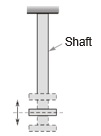
- Longitudinal Vibrations: If the shaft is elongated and shortened so that the same moves up and down resulting in tensile and compressive stresses in the shaft.
- Harmonic vibration: Vibration in which the motion is a sinsuoidal function of time.
- Fundamental vibration: Harmonic component of a vibration with the lowest frequency.
- Steady state vibration: When the particles of the body move in steady state condition or continuing period vibration.
- Transient vibration: Vibratory motion of a system other than the steady state.
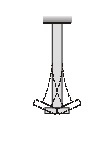
- Transverse Vibrations: When the shaft is bent alternately and tensile and compressive stresses due to bending result.
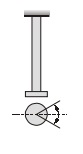
- Torsional Vibrations : When the shaft is twisted and untwisted alternately and torsional shear stresses are induced.
Free Longitudinal Vibrations
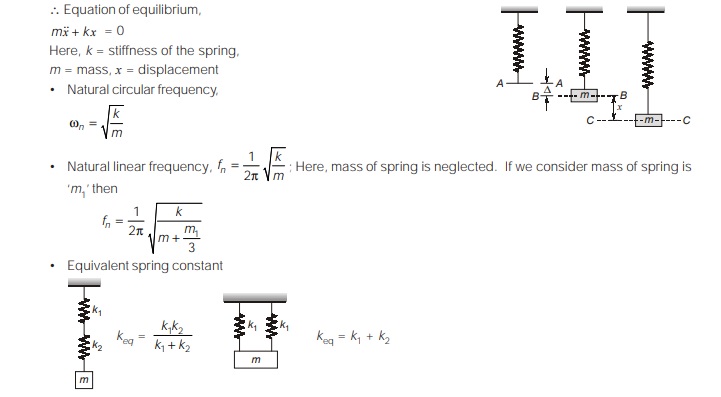
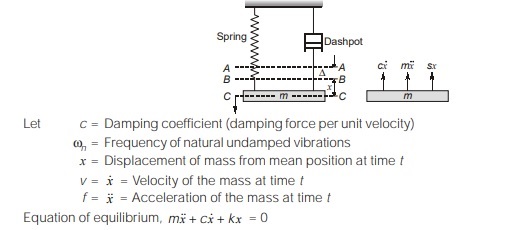
Damped Longitudinal Vibration
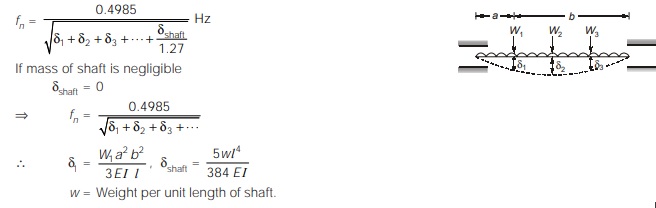
Dunkerley’s Method
Let W1, W2, W3, … be the concentrated loads on the shaft due to masses m1, m2, m3, … and δ1, δ2, δ3 … the static deflections of this shaft under each load when that load acts alone on the shaft. Let the shaft carry a uniformly distributed mass of m per unit length over its whole span and the static deflection at mid-span due to the load of this mass be δs. Also, let
fn = Frequency of transverse vibration of the whole system
<< Previous | Next >>
Must Read: What is the Theory of Machines?
Dear Aspirants,
Your preparation for GATE, ESE, PSUs, and AE/JE is now smarter than ever — thanks to the MADE EASY YouTube channel.
This is not just a channel, but a complete strategy for success, where you get toppers strategies, PYQ–GTQ discussions, current affairs updates, and important job-related information, all delivered by the country’s best teachers and industry experts.
If you also want to stay one step ahead in the race to success, subscribe to MADE EASY on YouTube and stay connected with us on social media.
MADE EASY — where preparation happens with confidence.

MADE EASY is a well-organized institute, complete in all aspects, and provides quality guidance for both written and personality tests. MADE EASY has produced top-ranked students in ESE, GATE, and various public sector exams. The publishing team regularly writes exam-related blogs based on conversations with the faculty, helping students prepare effectively for their exams.