Gauss’s Law
The total outward electric flux ψ through any closed surface is equal to the total charge enclosed by the surface.
In equation form, Gauss’s law is written as
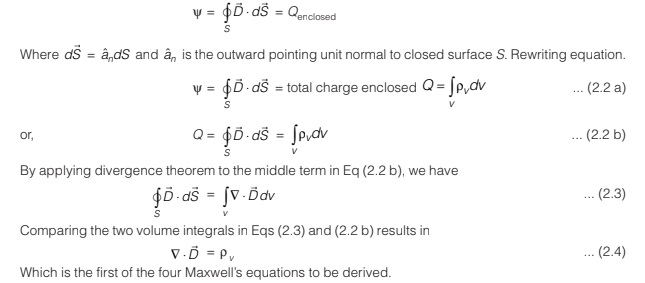
Which is the first of the four Maxwell’s equations to be derived.
Equation (2.4) states that the volume charge density is the same as the divergence of the electric flux density.
Note:
- Equations (2.3) and (2.4) are basically stating Guass’ law in different ways; equation (2.3) is the integral form and eq (2.4) is the point form or differential form of Gauss’s law.
- For symmetrical charge distributions, Gauss’s law provides an easy means of finding D or E.
Dear Aspirants,
Your preparation for GATE, ESE, PSUs, and AE/JE is now smarter than ever — thanks to the MADE EASY YouTube channel.
This is not just a channel, but a complete strategy for success, where you get toppers strategies, PYQ–GTQ discussions, current affairs updates, and important job-related information, all delivered by the country’s best teachers and industry experts.
If you also want to stay one step ahead in the race to success, subscribe to MADE EASY on YouTube and stay connected with us on social media.
MADE EASY — where preparation happens with confidence.

MADE EASY is a well-organized institute, complete in all aspects, and provides quality guidance for both written and personality tests. MADE EASY has produced top-ranked students in ESE, GATE, and various public sector exams. The publishing team regularly writes exam-related blogs based on conversations with the faculty, helping students prepare effectively for their exams.