AM Transmitters and Receivers
Broadcast transmitters can be classified according to carrier frequency.
Long wave transmitters below 300 kHz can be used for regional broadcast in temperate countries, where disturbances are not severe. They are propagated along ground and rapidly attenuated. Such transmitters are not economical.
Medium wave transmitter (525 kHz-1625 kHz) has a consistently good uniform coverage around the transmitter and is used as regional broadcast and transmitter carrier power varies from 1 kW to 1000 kW.
Short wave transmitters in the frequency range 3 MHz-30 MHz are used for long distance transmission, using ionospheric reflections. Carrier power need not to be high, because attenuation through ionosphere is not much. Frequencies above 25 MHz are not used in practice, due to difficulties in tuning the transmitter and matching the output to the transmission line without loss of power. To transmit all the signals need different kind of transmitter and receivers.
Transmitter
A transmitter not only performs the modulation process but also raises the power level of a modulated signal to the desired extent for effective radiation. The transmitters are divided into two categories: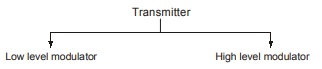
Receivers
It performs the function of selecting the desired signal from all other unwanted signals, amplifying and demodulating it and displaying it in the desired manner.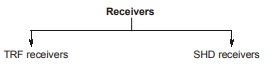
Tuned Radio Frequency Receivers (TRFR)
This receiver is now used only as a fixed frequency receiver.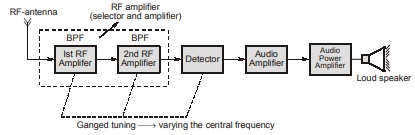
Super Heterodyne Radio Receiver (SHRR)
The Radio receiver used in an AM system is called superheterodyne AM receiver.
“Heterodyne” means → mixing of the signals in the mixer.
It is called as “Super Heterodyne” because frequency of local oscillator is always kept higher than the receiving signal frequency.
i.e., fLO > fs
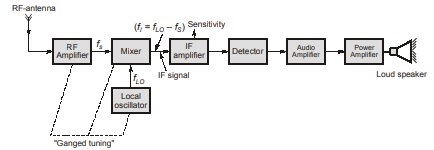
The SHRR performs detection in the following stages.
<< Previous | Next >>
Must Read: What is Communication?
Dear Aspirants,
Your preparation for GATE, ESE, PSUs, and AE/JE is now smarter than ever — thanks to the MADE EASY YouTube channel.
This is not just a channel, but a complete strategy for success, where you get toppers strategies, PYQ–GTQ discussions, current affairs updates, and important job-related information, all delivered by the country’s best teachers and industry experts.
If you also want to stay one step ahead in the race to success, subscribe to MADE EASY on YouTube and stay connected with us on social media.
MADE EASY — where preparation happens with confidence.

MADE EASY is a well-organized institute, complete in all aspects, and provides quality guidance for both written and personality tests. MADE EASY has produced top-ranked students in ESE, GATE, and various public sector exams. The publishing team regularly writes exam-related blogs based on conversations with the faculty, helping students prepare effectively for their exams.