Stress and Strain
Stress and Strain
Stress
It is the resistance offered by a body to deformation.
- Nominal stress (Engineering stress) = Load/ Original area
- Actual/True stress = Load/ Changed(Actual) area
Strain
- Deformation per unit length in the direction of deformation is known as strain. It is dimensionless.
- Strain = Change in dimension/ Original dimension
Engineering stress strain curve for mild steel for tension under static-loading.
- OA — Straight line (proportional region, Hookes law is valid)
- OB — Elastic region
- BC′ — Elasto plastic region
- CD — Perfectly plastic region
- DE — Strain hardening
- EF — Necking region
- A — Limit of proportionality, stress strain curve ceases to be a straight line.
- B — Elastic limit
- D — Strain hardening starts
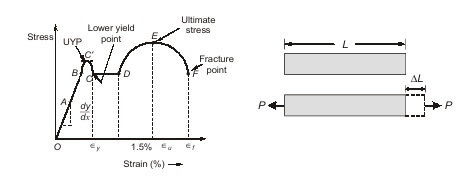
- Slope of OA=Modulus of elasticity (Young’s Modulus): It is constant of proportionality which is defined as the intensity of stress that causes unit strain.
- Plastic strain is 10 to 15 times elastic strain.
- Fracture strain (∈f) depends on percentage carbon in steel.
- When carbon percentage increases then fracture strain decreases and yield stress increases.

Dear Aspirants,
Your preparation for GATE, ESE, PSUs, and AE/JE is now smarter than ever — thanks to the MADE EASY YouTube channel.
This is not just a channel, but a complete strategy for success, where you get toppers strategies, PYQ–GTQ discussions, current affairs updates, and important job-related information, all delivered by the country’s best teachers and industry experts.
If you also want to stay one step ahead in the race to success, subscribe to MADE EASY on YouTube and stay connected with us on social media.
MADE EASY — where preparation happens with confidence.

MADE EASY is a well-organized institute, complete in all aspects, and provides quality guidance for both written and personality tests. MADE EASY has produced top-ranked students in ESE, GATE, and various public sector exams. The publishing team regularly writes exam-related blogs based on conversations with the faculty, helping students prepare effectively for their exams.