Rules of Probability
There are six rules of probability using which the probability of any compound event involving arbitrary events A and B, can be computed.
Rule 1:
p(A ∪ B) =p(A) + p(B) – p(A ∩ B)
This rule is also called the inclusion-exclusion principle of probability.
This formula reduces to
p(A ∪ B) =p(A) + p(B)
if A and B are mutually exclusive, since p(A ∩ B) = 0 in such a case.
Rule 2:
p(A ∩ B) =p(A) * p(B/A) = p(B) * p(A/B)
where p(A/B) represents the conditional probability of A given B and p(B/A) represents the conditional probability of B given A.
(a) p(A) and p(B) are called the marginal probabilities of A and B respectively. This rule is also called as the multiplication rule of probability.
(b) p(A ∩ B) is called the joint probability of A and B.
(c) If A and B are independent independent events, this formula reduces to
p(A ∩ B)=p(A) * p(B).
since when A and B are independent
p(A/B) = p(A)
and p(B/A) = p(B)
i.e. the conditional probabilities become same as the marginal (unconditional) probabilities.
(d) If A and B are independent, then so are A and BC; AC and B and AC and BC.
(e) Condition for three events to independent:
Events A, B and C are independent iff
p(ABC)=p(A) p(B) p(C)
p(AB)=p(A) p(B)
p(AC)=p(A) p(C) A, B, C are pairwise independent
p(BC)=p(B) p(C)
Note: If A, B, C are independent, then A will be independent of any event formed from B and C.
For instance, A is independent of B ∪ C.
Rule 3: Complementary Probability
p(A) = 1 – p(AC)
p(AC ) is called the complementary probability of A and p(AC) represents the probability that the event A will not happen.
p(A) = 1 – p(AC)
p(AC) is also written as p(A′)
Notice that
p(A) + p(A′) =1
i.e. A and A′ are mutually exclusion as well as collectively exhaustive.
Also notice that by De Morgan’s law since
AC ∩ BC = (A ∪ B)C
p(AC ∩ BC) =p(A ∪ B)C = 1 – p(A ∪ B)
i.e. p(neither A nor B) = 1 – p(either A or B)
Rule 4: Conditional Probability Rule
Starting from the multiplication rule
p(A ∩ B) =p(B) * p(A/B)
by cross multiplying we get the conditional probability formula
p(A/B) = p(A ∩ B)/p(B)
By interchanging A and B in this formula we get
p(B/A) = p(A ∩ B)/p(A)
Rule 5: Rule of Total Probability
Consider an event E which occurs via two different events A and B. Further more, let A and B be mutually
exclusive and collectively exhaustive events. This situation may be represented by following tree diagram
Now, the probability of E is given by value of total probability as
P(E) =P(A ∩ E) + P(B ∩ E) = P(A) * P(E/A) + P(B) *(E/B)
This is called rule of total probability.
Sometimes however, we may wish to know that, given that the event E has already occurred, what is the probability that it occurred with A? In this case we can use Bayes Theorem given below.
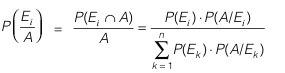
Rule 6: Baye’s theorem
If E1, E2, E3 …… EN are ‘n’ mutually exclusive events in a sample space ‘S’ such that S = E1 ∪ E2 ∪ E3 …….EN.
If A is any arbitrary event in sample space then, probability of even Ei when A has already occurred i.e.,
Dear Aspirants,
Your preparation for GATE, ESE, PSUs, and AE/JE is now smarter than ever — thanks to the MADE EASY YouTube channel.
This is not just a channel, but a complete strategy for success, where you get toppers strategies, PYQ–GTQ discussions, current affairs updates, and important job-related information, all delivered by the country’s best teachers and industry experts.
If you also want to stay one step ahead in the race to success, subscribe to MADE EASY on YouTube and stay connected with us on social media.
MADE EASY — where preparation happens with confidence.

MADE EASY is a well-organized institute, complete in all aspects, and provides quality guidance for both written and personality tests. MADE EASY has produced top-ranked students in ESE, GATE, and various public sector exams. The publishing team regularly writes exam-related blogs based on conversations with the faculty, helping students prepare effectively for their exams.