Formation of YBUS Matrix
YBUS can be formed using two methods namely.
- Direct inspection method
- Singular transformation method
1. Direct Inspection Method
Let us consider a two node system connected with the reference node-0 having respective impedances between them as shown here.
The admittances corresponding to the impedances as marked in figure will be –j10 (between node-0 and 2) and –j2 (between node-0 and 1) respectively.
Using direct inspection method, we conclude that the order of YBUS will be 2 × 2 matrix and given by
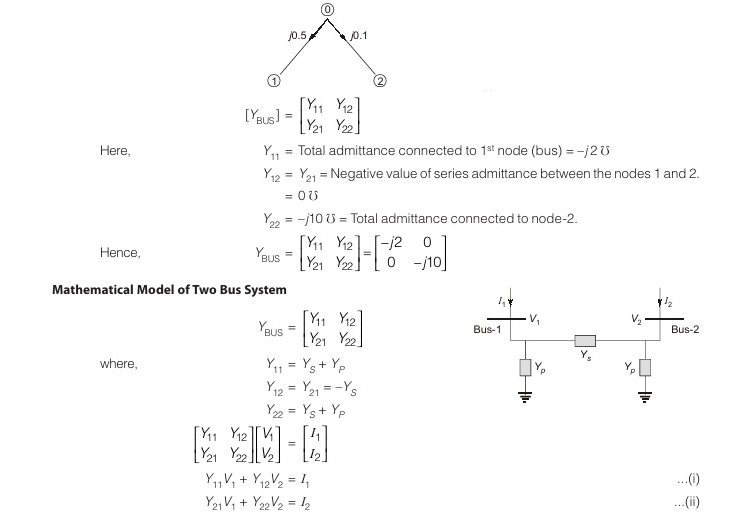
The eqn. (i) and (ii) relating bus voltage variable to injected current into the transmission system variable are linear algebraic simultaneous equation with complex coefficient.
This linear equations of algebraic can be solved analytically with the help of Cramer’s rules to find unknown bus voltage V1 and V2 if the injected current variable I1 and I2 are known.
In load flow study the bus data contains information about power not about current and hence eqn. (i) and (ii) are not useful in present state format in load flow study.
<< Previous | Next >>
Must Read: What is Power Generation?
Dear Aspirants,
Your preparation for GATE, ESE, PSUs, and AE/JE is now smarter than ever — thanks to the MADE EASY YouTube channel.
This is not just a channel, but a complete strategy for success, where you get toppers strategies, PYQ–GTQ discussions, current affairs updates, and important job-related information, all delivered by the country’s best teachers and industry experts.
If you also want to stay one step ahead in the race to success, subscribe to MADE EASY on YouTube and stay connected with us on social media.
MADE EASY — where preparation happens with confidence.

MADE EASY is a well-organized institute, complete in all aspects, and provides quality guidance for both written and personality tests. MADE EASY has produced top-ranked students in ESE, GATE, and various public sector exams. The publishing team regularly writes exam-related blogs based on conversations with the faculty, helping students prepare effectively for their exams.