Karnaugh Map
The “Karnaugh map” is a graphical method which provides a systematic method for simplifying and manipulating the Boolean expressions or to convert a truth table to its corresponding logic circuit in a simple, orderly process.
In this technique, the information contained in a truth table or available in SOP or POS form is represented on a K-map.
Although this technique may be used for any number of variables, it is generally used up to 6 variables, beyond which it becomes very cumbersome.
In n-variable K-map there are 2n cells.
“Gray code” has been used for the identification of cells.
Three-variable K-map
- Four cells
- Four minterms (maxterms)
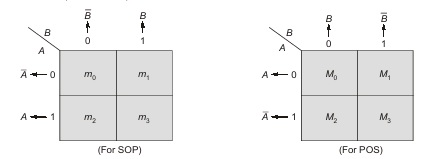
Three-variable K-map
- Eight cells
- Eight minterms (maxterms)
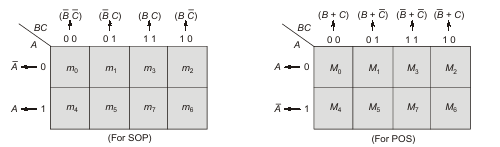
Four-variable K-map
- Sixteen cells
- Sixteen minterms (maxterms)
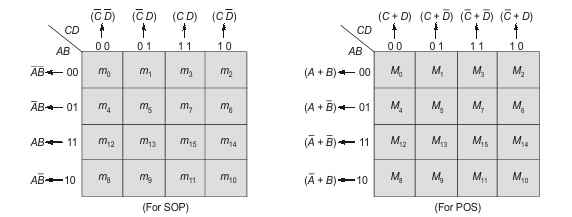
Implicant
Implicant is a product/sum term in sum of product (SOP) for which the function output must be 1 or sum/maxterm term in product of sum (POS) of a boolean function.
Prime Implicant
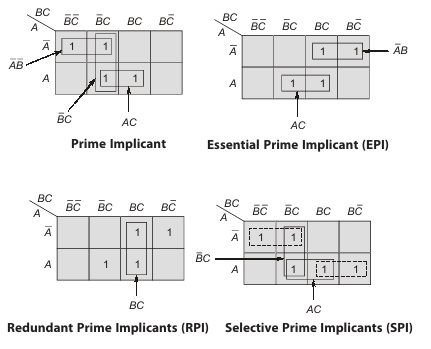
A prime Implicant is a smallest possible sum/product term of the given function, removing any one of the literal from which is not possible. All possible groups formed in K-map are prime implicants.
Example: Number of prime implicants = 3
Essential Prime Implicant (EPI)
- Essential Prime Implicant are those prime implicants which cover atleast one minterm in SOP or atleast one maxterm in POS that can’t be covered by any other prime implicant.
- Essential Prime Implicants (EPI) are those prime implicants which always appear in final solution.
Example: Number of Essential Prime Implicants (EPI) = 2.
Redundant Prime Implicants (RPI)
- The prime implicants for which each of its minterm/maxterm is covered by some essential prime implicants are redundant prime implicants (RPI).
- Redundant Prime Implicants (RPI) never appears in final solution.
Example: Redundant Prime Implicant (RPI) = BC
Selective Prime Implicants (SPI)
The prime implicants which are neither essential nor redundant prime implicants are called selective prime implicants. These are also known as non-essential prime implicants.
They may or may not appear in final solution.
Example: Number of selective prime implicants = 2.
<< Previous | Next >>
Must Read: What is Boolean algebra?
Dear Aspirants,
Your preparation for GATE, ESE, PSUs, and AE/JE is now smarter than ever — thanks to the MADE EASY YouTube channel.
This is not just a channel, but a complete strategy for success, where you get toppers strategies, PYQ–GTQ discussions, current affairs updates, and important job-related information, all delivered by the country’s best teachers and industry experts.
If you also want to stay one step ahead in the race to success, subscribe to MADE EASY on YouTube and stay connected with us on social media.
MADE EASY — where preparation happens with confidence.

MADE EASY is a well-organized institute, complete in all aspects, and provides quality guidance for both written and personality tests. MADE EASY has produced top-ranked students in ESE, GATE, and various public sector exams. The publishing team regularly writes exam-related blogs based on conversations with the faculty, helping students prepare effectively for their exams.