Surges in Open Channels
- A surge or surge wave is a moving wave front which brings about an abrupt change in depth of flow.
- A surge may be caused by various factors such as closer or opening of valves or gates, loading or unloading of turbines, start or stopping of pumps, failure of dams leading to flow of reservoir downstream etc.
- A surge is also often referred to as moving hydraulic jump and is caused by sudden increase or decrease in flow. Surges are classified as:
- Positive surge: It is the one which results in an increase in depth of flow.
- Negative surge: It is the one which causes a decrease in the depth of flow.
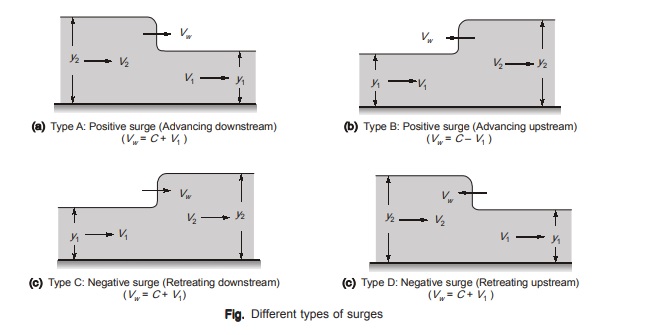
- Based on the movement of the surge either upstream or downstream, the various types of surges are:
- Type A: It may occur when a gate provided at the head of a channel is suddenly opened.
- Type B: It may occur when a gate provided at the tail end of a channel is suddenly closed.
- Type C: It may occur when a gate provided at the head of a channel is suddenly closed.
- Type D: It may occur when a gate provided at the tail end of a channel is suddenly opened.
Dear Aspirants,
Your preparation for GATE, ESE, PSUs, and AE/JE is now smarter than ever — thanks to the MADE EASY YouTube channel.
This is not just a channel, but a complete strategy for success, where you get toppers strategies, PYQ–GTQ discussions, current affairs updates, and important job-related information, all delivered by the country’s best teachers and industry experts.
If you also want to stay one step ahead in the race to success, subscribe to MADE EASY on YouTube and stay connected with us on social media.
MADE EASY — where preparation happens with confidence.

MADE EASY is a well-organized institute, complete in all aspects, and provides quality guidance for both written and personality tests. MADE EASY has produced top-ranked students in ESE, GATE, and various public sector exams. The publishing team regularly writes exam-related blogs based on conversations with the faculty, helping students prepare effectively for their exams.